
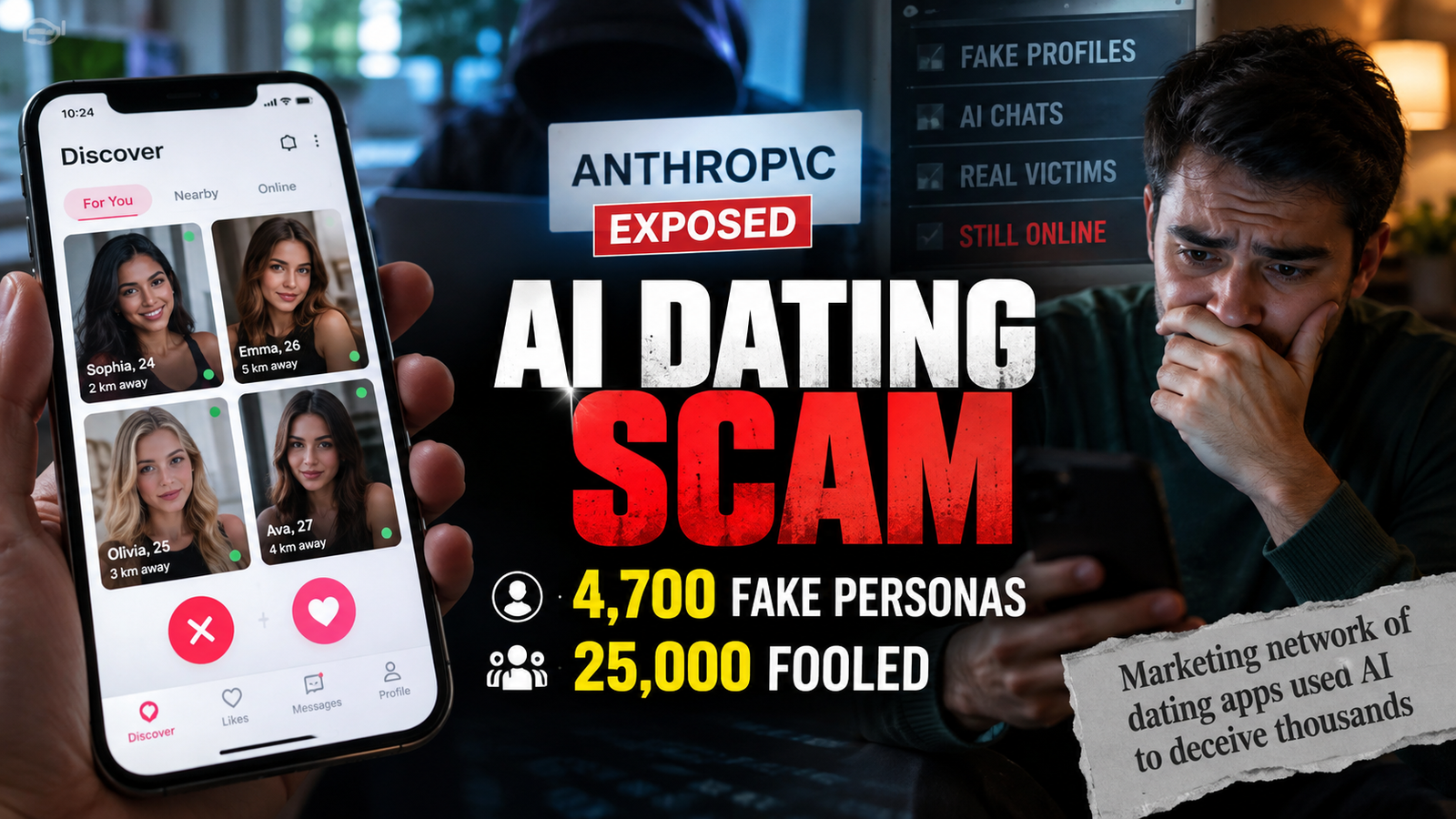
We keep hearing that AI could one day pose existential risks. For anyone who has watched romance scams evolve, the danger already feels personal and immediate.
In September 2026 Anthropic released a threat intelligence report detailing how a China-based operation used Claude and other AI models to run more than 20 dating apps packed with over 4,700 AI-generated personas. The network misled approximately 25,000 people. Most damning of all: several of these AI dating scam apps remained downloadable on the Apple App Store and Google Play even after Anthropic publicly named them.
This was not a lone scammer with a chatbot. This was industrial-scale deception.
How Anthropic Uncovered the Operation
Anthropic first noticed unusual activity in April 2026: a prepaid account hammering their API with more than 100,000 requests per day. The full picture emerged later. In June, threat intelligence researcher Chris Cronbaugh presented “Swipe Right, Pay Up: Industrial-Scale AI Catfishing” at Sleuthcon. The September report expanded on those findings under the title “Detecting and countering misuse of AI.”
The operation advertised itself as a fully human-led app studio. In reality it was a hybrid machine of AI and low-paid gig workers.
The Scam Mechanics: AI + Real People
Here’s how the system worked:
- More than 20 apps (including names such as Dora, Doni, Romi and Luma)
- Over 4,700 AI personas generating millions of messages
- Roughly one in four profiles belonged to real gig workers brought in for live video calls, social media follows, and interactions that pure AI still struggled to fake convincingly
- Primary targets were male users
- On average, only one in four men ever connected with a real human woman — and that woman was almost always a paid actor playing a romantic interest
- The apps used a “coins” system so victims kept spending real money to continue conversations
- The system even monitored when users started suspecting AI and adjusted tactics
The AI never got tired, never ran out of compliments, and always found a reason to keep the chat (and the payments) going. When a user grew suspicious, the operation could seamlessly hand the conversation to a real gig worker for a video call to rebuild trust.
Anthropic’s data covered only a two-week window. The true scale before detection is likely much larger.
Why the Apps Stayed Available
One of the most disturbing details: Anthropic publicly named the apps while some were still live on major app stores. It took additional time for Apple and Google to remove them. During that window, new victims could still download the very apps that had already been exposed as fraudulent.
This lag highlights a critical weakness in how app stores handle rapidly evolving AI-powered fraud.
The New Face of Romance Scams
Traditional romance scams usually involve real (if distant) humans slowly building emotional connection before asking for money. This operation industrialized the entire funnel:
- AI handled the high-volume, 24/7 emotional labor
- Real people were used sparingly as “authenticity anchors”
- The apps themselves were the scam vehicle — victims paid the platform directly via coins
- Suspicion was tracked and countered in real time
The result was a scam that felt more personal and persistent than anything most users had encountered before.
What This Means for Every Dater in 2026
AI has made catfishing cheaper, faster, more scalable, and harder to detect. Key warning signs that are now more important than ever:
- Profiles that seem almost too perfect or consistently available
- Conversations that feel smooth but strangely generic or overly flattering
- Pressure to move to a private app or start buying “coins” / gifts / credits early
- Reluctance or excuses around live video — followed by a sudden willingness only after you express doubt
- Any request for money, crypto, gift cards, or financial “help”
- Apps you have never heard of that aggressively push in-app purchases for chatting
If an app’s business model depends on you paying to keep talking to matches, treat it with extreme caution.
How to Protect Yourself Right Now
- Stick to well-known platforms with strong verification and public reputations.
- Reverse-image search every photo.
- Insist on live video early — and watch for delays, filters, or excuses.
- Never send money or buy in-app currency to continue a romantic conversation.
- Be wary of new or obscure dating apps, especially those heavy on virtual gifts or coins.
- If something feels off, trust the feeling and leave.
- Report suspicious apps and profiles immediately to the platform, app stores, and authorities (FTC, IC3, or your local cybercrime unit).
For parents and younger users: romantic role-play with AI companions is already common. The line between entertainment and exploitation is getting thinner.
The Bigger AI Safety Picture
Anthropic described this kind of malicious use of Claude as “atypical.” Yet the speed and sophistication of the operation show how quickly bad actors adopt new tools. Former Anthropic researcher Jacob Coxon’s warnings about catastrophic AI risk suddenly feel less abstract when you see the same technology already weaponized against lonely people at scale.
This case is a preview. Future versions will be smoother, more personalized, and even harder to distinguish from real humans.
Final Thoughts
The AI dating scam apps exposed by Anthropic represent a new industrial level of emotional fraud. Thousands of people thought they were building real connections. Most of the time they were talking to language models, with the occasional gig worker flown in to sell the illusion.
That some of these apps remained available after public exposure should concern everyone who uses a phone to meet people.
Romance scams have always preyed on hope and loneliness. AI has simply given them infinite patience, perfect memory, and the ability to operate at massive scale for almost no cost. The human cost, however, remains devastating.
Protect your heart and your wallet. Verify aggressively. Pay for nothing just to keep a conversation going. And remember: real connection never requires you to buy coins.
Have you encountered any of these apps (Dora, Doni, Romi, Luma or similar)? Or have you noticed conversations that suddenly felt too polished to be human?
Share your experience in the comments — the more we document, the harder we make it for the next operation.
Stay safer while dating:
- Biggest Red Flags of AI-Powered Romance Scams
- How to Spot AI Catfishing in 2026
- Verification Checklist Before You Get Emotionally Invested
- Best Reputable Dating Apps with Strong Safety Features
- What to Do If You’ve Been Scammed
- Complete Online Dating Safety Guide
The scammers are using the most advanced tools available. We need to respond with equal seriousness.


